What If One Important Part of Nutrition Could Become Measurable in 15 Seconds?
PRYSM iO measures skin carotenoid levels through a simple, non-invasive fingertip scan — creating an objective starting point for conversations about diet, nutrition and lifestyle, and something that can be measured again over time.
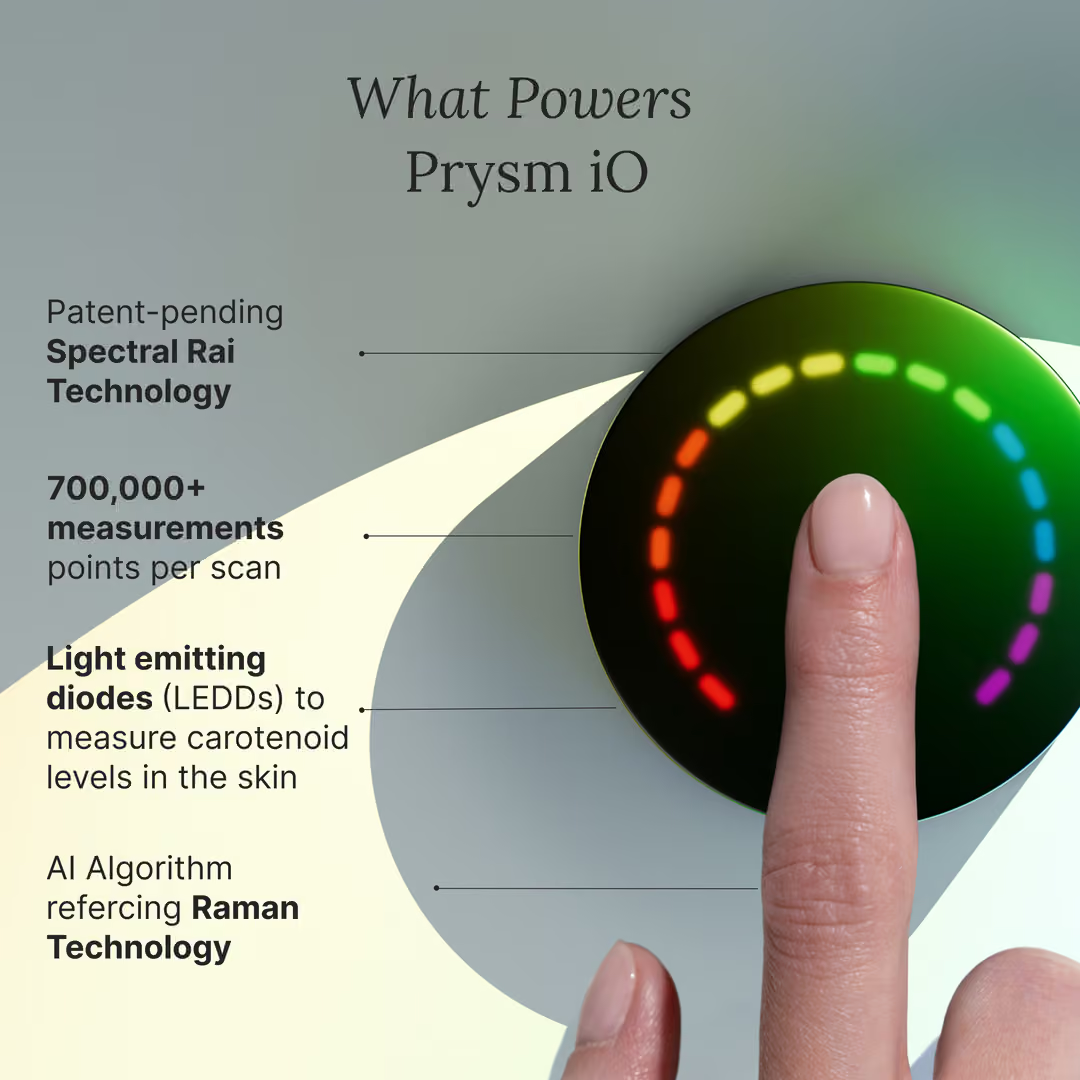
PRYSM Runs on Spectral Rai Technology
PRYSM iO uses patent-pending Spectral Rai™ technology. In 15 seconds, the device collects a large number of hyperspectral absorption measurements at the skin, and a machine-learning calibration engine maps those measurements against reference data to produce a single, personalised PRYSM Score.
That calibration draws on an extensive body of measurement science and reference data built up over more than two decades through the earlier BioPhotonic Scanner platform, which used resonance Raman spectroscopy. PRYSM iO itself uses a different optical measurement approach — Raman spectroscopy is not the physical scanning method PRYSM performs, but it remains an established reference and calibration foundation for skin carotenoid measurement, described below.
One Number. One Specific Measurement.
A user rests a fingertip on the PRYSM iO device for 15 seconds while it measures skin carotenoid levels. The result is shown as a score, giving a reference point that can be compared against future scans over time.
It provides an objective starting point, something tangible to discuss, something that can be measured again, and a way of observing changes in skin carotenoid score over time.
See PRYSM in Action
One Finger. 15 Seconds. One Simple Score.
Place a fingertip on PRYSM iO and, in 15 seconds, sophisticated optical measurement becomes a simple numerical skin carotenoid score.
Scan
Place your fingertip on PRYSM iO.
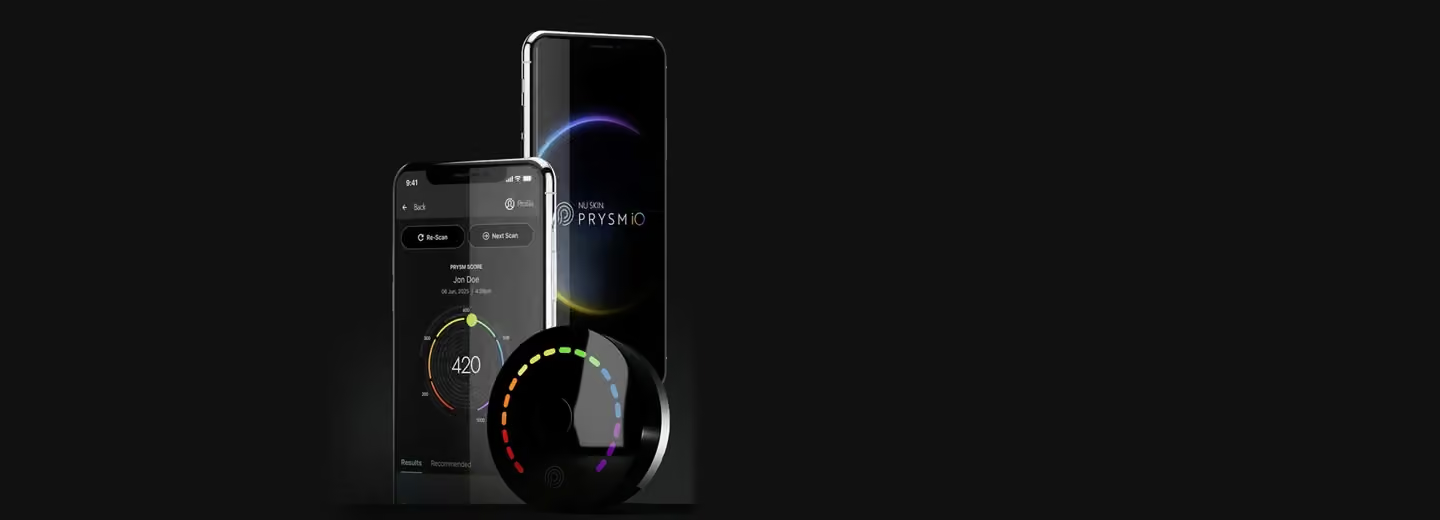
See Your Score
Your skin carotenoid measurement becomes a simple PRYSM Score.
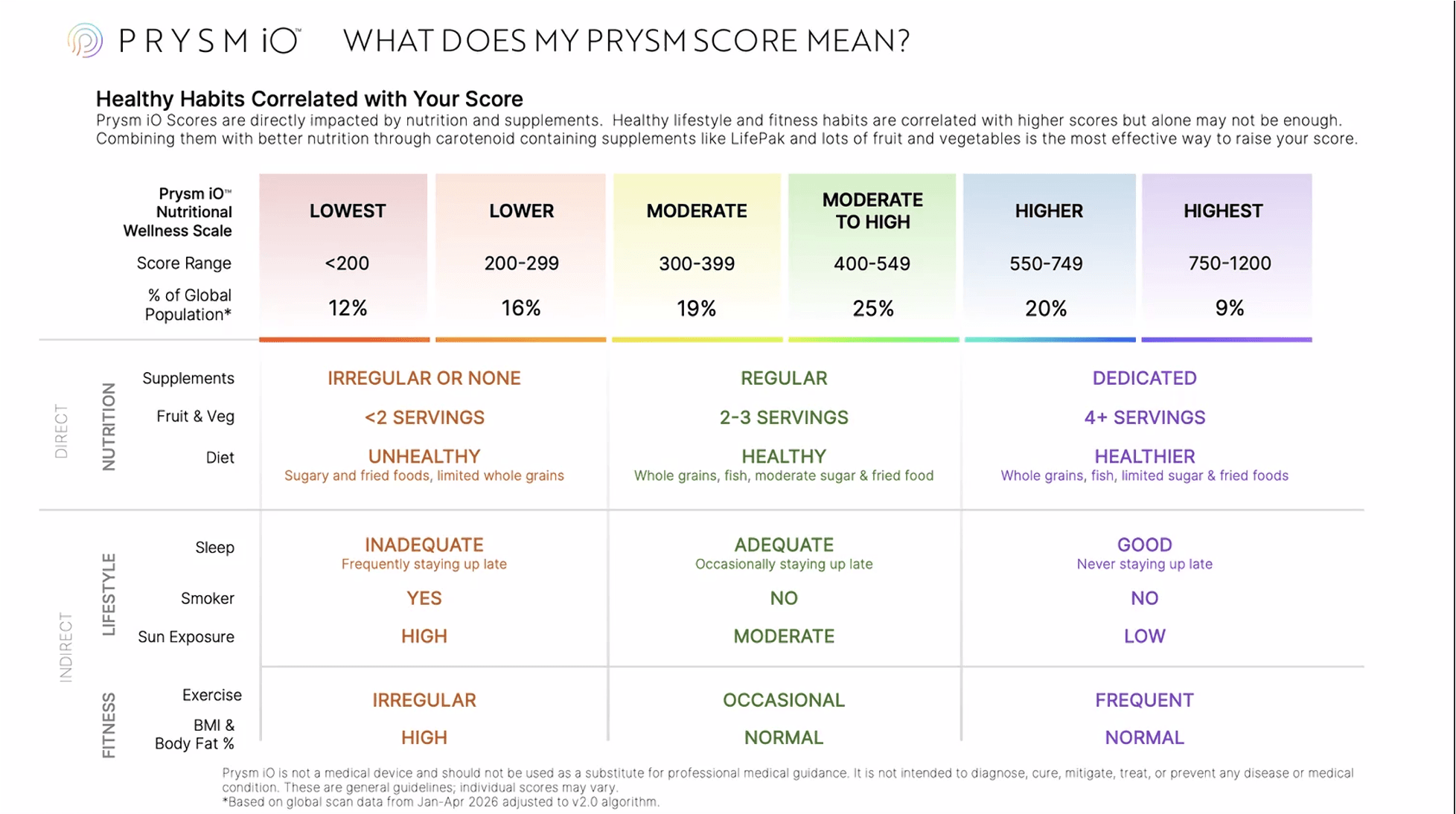
Understand
See where your measurement sits and create a natural wellness conversation around the result.
One Number Makes the Conversation Simple
The science behind the measurement is sophisticated. The experience doesn’t need to be. PRYSM turns the measurement into a simple score that can be recorded and compared with future scans — giving people an easy-to-understand reference point for the conversation.
From Measurement to Conversation
A simple measurement creates immediate curiosity. What does my score mean? What influences it? Can it change? When should I scan again? That curiosity creates a natural reason to start a conversation — and another reason to continue it.
The Score Is the Starting Point.
The dedicated PRYSM app combines the individual’s score and lifestyle information with AI-powered technology supported by insights from more than 20 million historical scans to provide personalised guidance across nutrition, lifestyle, fitness and supplementation.
Nutrition · Lifestyle · Fitness · Supplementation
The result is more than a measurement: it’s a starting point for understanding, a guide for action, and a benchmark to track over time.
You Know What You Eat. You Know What You Take. But What Can You Actually Measure?
Food, supplementation, or a combination of both — knowing what you consume is one thing. Being able to measure a relevant biomarker is another.
PRYSM iO measures skin carotenoid status: a measurable biomarker that can be tracked over time. It takes an otherwise largely invisible part of nutrition and makes it visible.
A Hidden Nutrition Challenge Affecting Billions
Having enough calories does not necessarily mean a diet provides adequate amounts of every essential micronutrient — and inadequate intake affects billions of people globally. Independent modelling published in The Lancet Global Health quantifies the scale, examining estimated inadequate dietary intake across 15 essential micronutrients and 185 countries.
Estimated to have inadequate dietary intake of key micronutrients
Countries included in the analysis
Of the global population represented
Micronutrients analysed
More than 5 billion people had estimated inadequate intake of iodine, vitamin E, and calcium.
More than 4 billion people had estimated inadequate intake of iron, riboflavin, folate, and vitamin C.
Figures are modelled estimates of inadequate dietary intake from food, not diagnosed clinical deficiencies.
And India Stands Out
India shows especially high estimated inadequate dietary intake of several key micronutrients — identified by independent modelling published in The Lancet Global Health:
The broader research also demonstrates that inadequate dietary intake of multiple micronutrients is widespread globally, not unique to any one country.
The Device Itself Has Been Evaluated
Beyond the underlying science, university research has examined PRYSM iO itself — not simply the measurement principle it draws on.
Blood Serum Carotenoid Correlation
University research examined PRYSM iO readings against blood serum carotenoid levels, an established laboratory measure of carotenoid status.
Diet, Lifestyle & Metabolic Markers
Research conducted with Jiao Tong University mapped how diet quality, lifestyle habits, skin health and metabolic markers relate to PRYSM Score outcomes.
PRYSM Score & Healthy Ageing
In preliminary collaborative research with Dr Anne Chang at Stanford Medicine, higher PRYSM Scores were consistently associated with more favourable biological-ageing measures across multiple independent ageing clocks.
Difference observed between higher and lower PRYSM Score groups across the ageing measures examined.
High-PRYSM Scorers Looked Younger Across Every System
How many years younger each body system appeared in higher-PRYSM scorers compared with lower-PRYSM scorers.
Across all 11 systems analysed, higher PRYSM Scores were associated with younger biological-age estimates.
How This Was Measured
The preliminary analysis used four biological-ageing clocks — Symphony Age, Pace of Ageing, Telomere Biological Age and OMICm Age — together with telomere length as an additional biomarker.
Collaborative research with Stanford Medicine · N=33 · Publication pending
The Science Behind Skin Carotenoid Measurement
Optical measurement of skin carotenoids has a substantial scientific history. Independent, peer-reviewed research has examined the relationship between skin carotenoid measurements, circulating blood carotenoids and dietary intake — including a 2020 systematic review of 29 studies finding significant associations between spectroscopy-based skin carotenoid measurements and both blood carotenoid levels and reported fruit and vegetable intake. This is the scientific foundation Spectral Rai technology builds on.
One Scan Creates a Conversation. Leadership Creates Scale.
PRYSM turns invisible nutrition into a simple, measurable number — and a number is easy to start a conversation with. India’s scale means those individual conversations can add up quickly, and some of the people having them will turn out to be leaders capable of carrying the idea into new communities.
Building a significant business and creating greater nutrition awareness don’t have to be separate goals — they can grow together, person by person, community by community.
Business Can Create Reach. Technology Can Create Engagement. People Can Create Change.
Technology Opens the Conversation. Experience Helps Build What Comes Next.
A technology can start a conversation. But people carry ideas into communities. Leaders develop other people. Our experience has taught us that markets are ultimately developed person by person — through education, relationships, leadership and people capable of carrying an idea into their own communities. The scale of India makes developing great leaders particularly important.
International business-building experience
in cumulative sales generated across new and developing markets
Great leaders identified, mentored and developed around the world
“India may be a new market. Building new markets isn't new to us.”
Science & Sources
The Nutrition Challenge — Independent Research
- Passarelli S, Free CM, Shepon A, Beal T, Batis C, Golden CD. Global estimation of dietary micronutrient inadequacies: a modelling analysis. Lancet Glob Health. 2024;12(10):e1590–e1599. View
Modelled estimates of inadequate dietary intake from food, excluding fortification and supplementation.
PRYSM Technology & Validation — University Research
- Blood serum carotenoid correlation with PRYSM iO.
University research validating PRYSM iO readings against blood serum carotenoid levels as a non-invasive biomarker.
- Jiao Tong University — diet, lifestyle, skin and metabolism vs. PRYSM Score.
University research mapping how diet quality, lifestyle habits, skin health and metabolic markers correlate with PRYSM Score outcomes.
Emerging PRYSM Research — Research Collaboration
- Collaborative research with Dr Anne Chang, Stanford Medicine — PRYSM Score and biological-ageing measures.
Preliminary collaborative research (N=33). Publication pending. Individually, none of the four ageing clocks reached conventional statistical significance, although all four showed a consistent directional trend worthy of further investigation in larger studies.
Foundational Carotenoid Science — Independent Research
- Radtke MD, Jilcott Pitts S, Jahns L, Firnhaber GC, Loofbourrow BM, Zeng A, Scherr RE. Criterion-related validity of spectroscopy-based skin carotenoid measurements as a proxy for fruit and vegetable intake: a systematic review. Adv Nutr. 2020;11(5):1282–1299. View
- Mayne ST, Cartmel B, Scarmo S, Jahns L, Ermakov IV, Gellermann W. Resonance Raman spectroscopic evaluation of skin carotenoids as a biomarker of carotenoid status for human studies. Arch Biochem Biophys. 2013;539(2):163–170. View
- Scarmo S, Henebery K, Peracchio H, Cartmel B, Lin H, Ermakov IV, Gellermann W, Bernstein PS, Duffy VB, Mayne ST. Skin carotenoid status measured by resonance Raman spectroscopy as a biomarker of fruit and vegetable intake in preschool children. Eur J Clin Nutr. 2012;66(5):555–560. View
- Jahns L, Johnson LK, Conrad Z, Bukowski M, Raatz SK, Jilcott Pitts S, Wang Y, Ermakov IV, Gellermann W. Concurrent validity of skin carotenoid status as a concentration biomarker of vegetable and fruit intake compared to multiple 24-h recalls and plasma carotenoid concentrations across one year: a cohort study. Nutr J. 2019;18:78. View
- Ermakov IV, Sharifzadeh M, Ermakova M, Gellermann W. Resonance Raman detection of carotenoid antioxidants in living human tissue. J Biomed Opt. 2005;10(6):064028. View
See PRYSM in Context
Explore how this technology fits into the wider India opportunity, or see it for your business.